

In this article 10 sections
The check-in counter is the worst possible place to discover your onward travel proof does not work. The flight is boarding, the agent is shaking their head at your PDF, and your options have collapsed to two: buy whatever full-price ticket the airline will sell you, or stay behind.
Airlines check because they carry the liability: if a passenger is refused entry for missing onward proof, the carrier can be fined and must fly them back. Agents therefore verify against the destination's rules — and they verify quickly. What survives that check, and what fails, is remarkably consistent. These are the seven mistakes that fail, in the order they usually surface.
Key takeaways
- Agents don't judge how a document looks — they check whether it resolves in a live system. Screenshots and edited PDFs fail there.
- The reference on your document must be the airline's own record locator, verifiable on the carrier's public website — not an agency or booking-platform code.
- Names must match the passport exactly, and the onward date must fall inside your permitted stay.
- Verify your own proof online before leaving for the airport — it takes thirty seconds and removes every surprise.
For official checks before departure, keep IATA Travel Centre handy.
Mistake 1: showing up with nothing
The classic. Many travelers with one-way tickets assume onward proof is an immigration question they will handle on arrival. But the airline checks before boarding, and requirements vary wildly by destination and passport — the ground truth agents consult is the same database behind the IATA Travel Centre. If your destination requires exit proof, the agent needs a document, not an explanation.
Avoid it: check the requirement for your passport and destination before every one-way trip, and arrive with proof already in hand. The complete guide to proof of onward travel covers what qualifies.
Mistake 2: an edited PDF or a screenshot
The most dangerous mistake, because it can escalate beyond denied boarding. Agents can look up a reservation code in seconds; an edited itinerary whose PNR does not exist — or belongs to someone else's booking — fails instantly, and presenting fraudulent travel documents is treated far more seriously than having none.
Avoid it: only carry proof whose reference resolves in a live system. A verifiable onward reservation is a real booking in the airline's system — that is precisely what makes it useful.
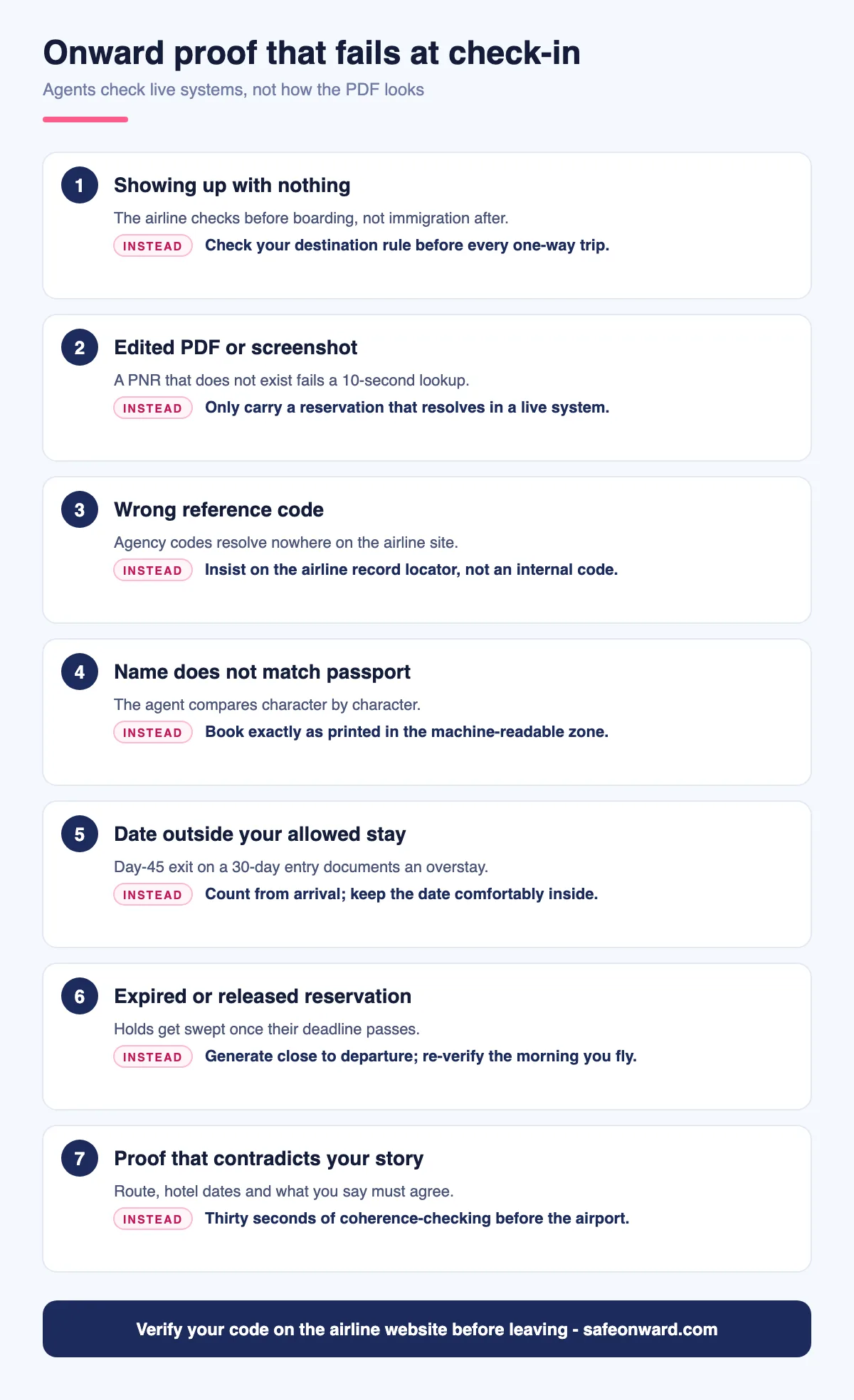
Mistake 3: a reference the airline's website doesn't recognise
Subtler than a fake, and it trips up travelers with genuine bookings. Reservations bought through platforms and agencies often come with the intermediary's internal code — which resolves nowhere on the airline's site. And some carriers, particularly low-cost ones, don't expose held reservations on their public pages at all.
Avoid it: the code on your document must be the airline record locator, checked against the operating carrier's own "Manage booking" page. When a service issues your reservation, that airline-verifiable reference is the thing to insist on — it is the difference between a document that answers questions and one that raises them.
Mistake 4: name doesn't match the passport
The agent compares your proof against your passport, character by character. A missing middle name usually survives; a different surname, a maiden name, or names in the wrong order usually doesn't — the agent cannot be sure the reservation is yours.
Avoid it: book onward proof with your name exactly as printed in the passport's machine-readable zone. If your name was recently changed, make every travel document agree with the passport you are flying on.
Mistake 5: onward date outside your permitted stay
A 30-day visa exemption with an onward flight on day 45 is not proof of leaving on time — it is documented proof of intent to overstay, which is worse than no document.
Avoid it: count the days from your arrival date and keep the onward date comfortably inside the window. If your plans are genuinely open, set a conservative exit date — what matters at the counter is a compliant, coherent plan.
Mistake 6: an expired or already-released reservation
Temporary reservations have a validity window; airline holds get swept once their ticketing deadline passes. Proof generated days ago can be dead by the time you reach the counter — valid-looking PDF, nothing behind it.
Avoid it: timing. Generate or activate your reservation close to departure so its validity covers check-in and arrival — same-day onward tickets exist precisely for this. If your reservation offers scheduled activation, align it with your flight, and re-verify the code the morning you travel.
Mistake 7: proof that contradicts the rest of your story
If the document needs to be ready quickly, you can book a verifiable onward ticket before check-in or submitting your file.
The document works; the story doesn't. Your onward flight leaves from a different country with no explanation of how you get there. Your hotel booking ends a week after your onward flight departs. You tell the agent "two weeks" and hand over a reservation showing five days. Individually small; together they make an agent slow down — and slow agents ask for supervisors.
Avoid it: thirty seconds of coherence-checking. Route, dates, accommodation, and what you say out loud should form one story. Land borders and multi-country routes are fine — just be ready to name the bus, train, or budget flight that connects the dots.
The pre-airport verification ritual
Before every trip that relies on onward proof:
- Open the operating airline's website and look up your reference with your last name.
- Confirm the name shown matches your passport exactly.
- Confirm the onward date sits inside your permitted stay counted from your actual arrival.
- Save the PDF offline and screenshot the airline's own confirmation page next to it.
- If anything fails to resolve, fix it from your hotel — not at the counter.
Frequently asked questions
Do airlines really check, or is this rare?
It varies by route, carrier, and even agent — many travelers fly one-way for years unchecked. But enforcement is exactly as unpredictable as airline fine exposure makes it, and the cost asymmetry is brutal: a verified document costs little; a forced airport ticket purchase costs hundreds.
Is a bus or train ticket out of the country acceptable?
Often yes — many destinations accept any documented exit, not only flights. It must be a real, dated booking in your name. A flight reservation remains the most universally recognised format at airline counters.
My onward reservation is with a different airline than the one I'm flying. Is that a problem?
No. The agent checks that exit proof exists and is verifiable, not that it is on their carrier. What matters is that the reference resolves on the operating airline's website.
What if the agent cannot find my reservation?
Stay calm, show the airline's own confirmation screenshot from your morning check, and ask them to search by full name and flight date. If it genuinely cannot be found, you are in mistake 3 or 6 territory — this is why the pre-airport ritual exists.
Create a temporary flight reservation for visa files, airline checks, or proof of onward travel.