
In this article 5 sections
A visa refusal feels personal, but it almost never is. Officers process hundreds of files and decide on paper logic: does this application tell one coherent, verifiable story? When it does not, the file is refused — often for a reason you could have fixed in an afternoon.
For more context around this step, compare it with Onward ticket same day guide.
This guide walks through the refusal reasons officers actually use, what each one really means, and the concrete fix for each. If your refusal was for a Schengen visa and you are deciding between appealing and reapplying, the companion guide on how to appeal a Schengen visa refusal covers deadlines country by country.
Key takeaways
- Most refusals come down to five things: documentation gaps, unclear itinerary, insufficient funds, weak home ties, and inconsistencies between documents.
- Officers decide on what the file proves, not what you intended. A true story badly documented reads the same as a false one.
- A refusal is rarely permanent. Fix the stated reason, document it, and reapply with a short cover letter that addresses the refusal head-on.
- Never buy a full-price flight before approval — embassies themselves advise against it. A verifiable flight reservation documents your itinerary without the financial risk.
For official checks before departure, keep IATA Travel Centre handy.
How officers actually read your file
A consular officer typically has a few minutes per application. In that time they check three things: that every required document is present and legible, that the documents agree with each other, and that the overall picture makes it credible you will use the visa as declared and leave on time.
That last point is the one applicants underestimate. The officer is not only verifying papers — they are scoring the risk that you overstay. Everything in your file either raises or lowers that perceived risk.
The refusal reasons that actually happen — and the fix for each
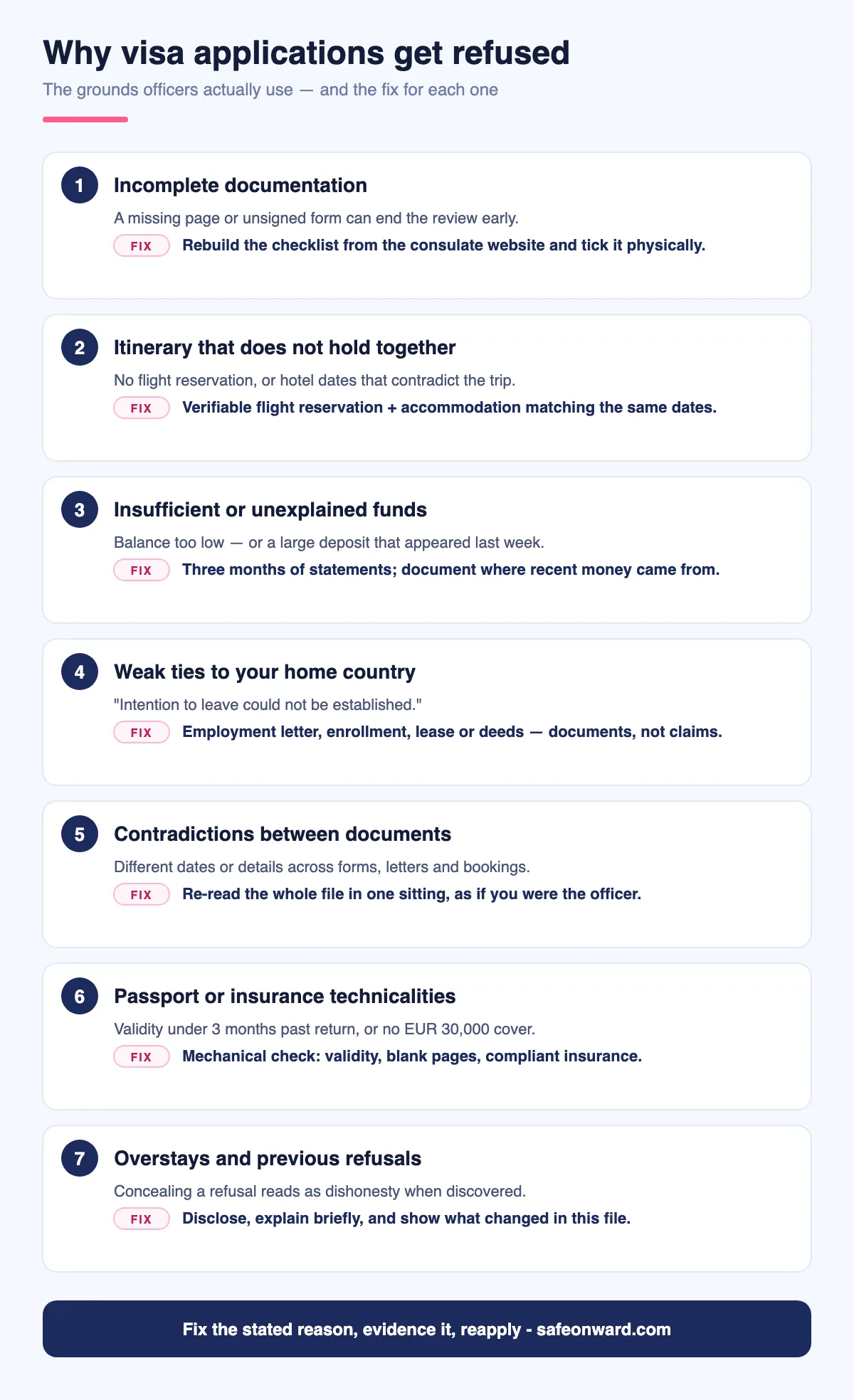
1. Incomplete or inconsistent documentation
The most common and most fixable reason. A missing bank statement page, an expired passport scan, an unsigned form — any of these can end the review early.
The fix: rebuild the checklist from the consulate's own website (not a forum), print it, and tick each item physically. Then cross-check the details that appear in more than one document: names spelled identically, dates that agree, addresses that match.
2. Travel itinerary that does not hold together
Officers look for a documented route: how you arrive, where you stay, when and how you leave. An application with no flight reservation, or with hotel dates that do not match the declared travel dates, reads as an unplanned trip — and unplanned trips are risky trips.
The fix: include a flight reservation for your visa application covering entry and exit dates, plus accommodation that matches those dates exactly. Crucially, do not buy a non-refundable ticket before the decision: consulates explicitly warn against it, and a refusal would cost you the fare. A verifiable reservation — a real booking the consulate can look up — documents the itinerary without locking in the money. The complete checklist for visa flight reservations covers formats and timing.
3. Insufficient or unexplained funds
Every consulate has an implicit (sometimes published) daily amount you should be able to cover. But the raw balance is only half the test — the other half is whether the money is yours and stable. A large deposit that appeared last week looks like borrowed window-dressing.
The fix: provide three months of statements, not a screenshot of today's balance. If a relative or company sponsors you, document the relationship and their funds formally. If a recent deposit is legitimate (salary, property sale), attach the proof of where it came from.
4. Weak ties to your home country
This is the refusal reason behind vague phrases like "intention to leave could not be established." The officer could not see what pulls you back: a job, studies, family, property, a business.
The fix: documents, not declarations. An employment letter stating your position and approved leave dates. Enrollment certificates. Property deeds or a rental contract. A letter explaining ties helps only when each claim in it is backed by an attached document.
5. Contradictions between documents
An invitation letter that says two weeks while the reservation shows one. A sponsor in one city, a hotel in another, with no explanation. Employment letter says accountant, application form says student. Each contradiction plants doubt, and doubt is refusal fuel.
The fix: read your entire file in one sitting before submitting, as if you were the officer. Anything that raises a question you would ask — answer it in the cover letter before it is asked.
6. Passport or insurance technicalities
Schengen files need a passport valid three months beyond your return with two blank pages, and travel insurance covering at least €30,000 in medical costs across all member states. These are hard rules — the file fails without them regardless of its quality. The EU's official requirements are published on the European Commission's visa policy pages.
If the document needs to be ready quickly, you can book a verifiable onward ticket before check-in or submitting your file.
The fix: mechanical. Check validity, order compliant insurance, verify the certificate names the Schengen area explicitly.
7. Your history — overstays and previous refusals
A past overstay or a fresh refusal from another country weighs on the file. Hiding it is worse than owning it: consulates share data, and a concealed refusal discovered later reads as dishonesty, which is much harder to repair.
The fix: disclose, briefly explain, and show what changed. A previous refusal fixed by a stronger file is a normal story officers see every day.
Reapply or appeal?
After a refusal you usually have two paths. Reapplying is faster when the refusal reason is real and fixable — missing document, thin funds, weak itinerary. Fix it, evidence it, and submit a short cover letter that names the previous refusal and what changed. Appealing makes sense when you believe the refusal was factually wrong — the deadline is short and the process is country-specific, so check the country-by-country appeal guide quickly after receiving the decision.
Whichever path you take, do not simply resubmit the same file. An identical application produces an identical refusal, and repeated refusals start to weigh on their own.
Frequently asked questions
Does a refusal ban me from applying again?
No. You can reapply immediately. What matters is that the new application visibly fixes the stated refusal reason.
Should I buy a real flight ticket to look more serious?
No — and several consulates explicitly tell applicants not to buy tickets before approval. Use a verifiable reservation instead; it documents the itinerary the officer needs without risking the fare. See how proof of onward travel works.
The refusal letter only shows a ticked box. How do I know what was really wrong?
The ticked ground is the legal reason; map it against your file honestly. "Justification for the purpose and conditions of the intended stay was not provided" usually means itinerary or documentation gaps. "Intention to leave could not be established" means ties. When in doubt, fix the two or three weakest points at once.
How long should I wait before reapplying?
There is no mandatory wait. The only real timer is how long it takes you to genuinely fix the refusal reason and gather the documents that prove it.
Create a temporary flight reservation for visa files, airline checks, or proof of onward travel.