

In this article 7 sections
Every Schengen refusal arrives on the same standard form: a sheet with ticked boxes explaining the legal grounds, and — somewhere near the bottom — a paragraph naming the authority you can appeal to and the deadline. That paragraph is the single most important text on the page, and most applicants never read it.
For more context around this step, compare it with How to get proof of onward travel.
This guide explains how to read the refusal form, when an appeal is worth it versus a fresh application, and the appeal routes commonly published for the main Schengen countries. One rule above everything: the instructions printed on your own refusal letter always override any general guide, including this one. Rules change; your letter is the authority.
Key takeaways
- You always have two options after a refusal: appeal the decision, or fix the file and reapply. For most fixable refusals, reapplying is faster.
- Appeal deadlines are short — typically 15 to 30 days from notification. Read your refusal letter the day you receive it.
- The appeal goes to the country that refused you (the member state whose consulate decided), not to the EU.
- An appeal argues the decision was wrong on the facts or the law. It is not the place to submit the documents you forgot — that is what reapplying is for.
For official checks before departure, keep IATA Travel Centre handy.
First: decode the refusal form
The standard form lists numbered grounds. The ones travelers see most:
- Purpose and conditions of stay not justified — the officer could not verify why you are going or how the trip is organised. Usually an itinerary and documentation problem: see why applications get refused and how to fix each reason.
- Insufficient means of subsistence — the funds shown did not cover the trip, or their origin was unclear.
- Intention to leave the territory could not be established — the file did not demonstrate ties pulling you home. This is the most subjective ground, and the one where a well-argued appeal or a visibly stronger reapplication can genuinely change the outcome.
- Travel medical insurance not proven — mechanical failure; almost always better to reapply with compliant insurance than to appeal.
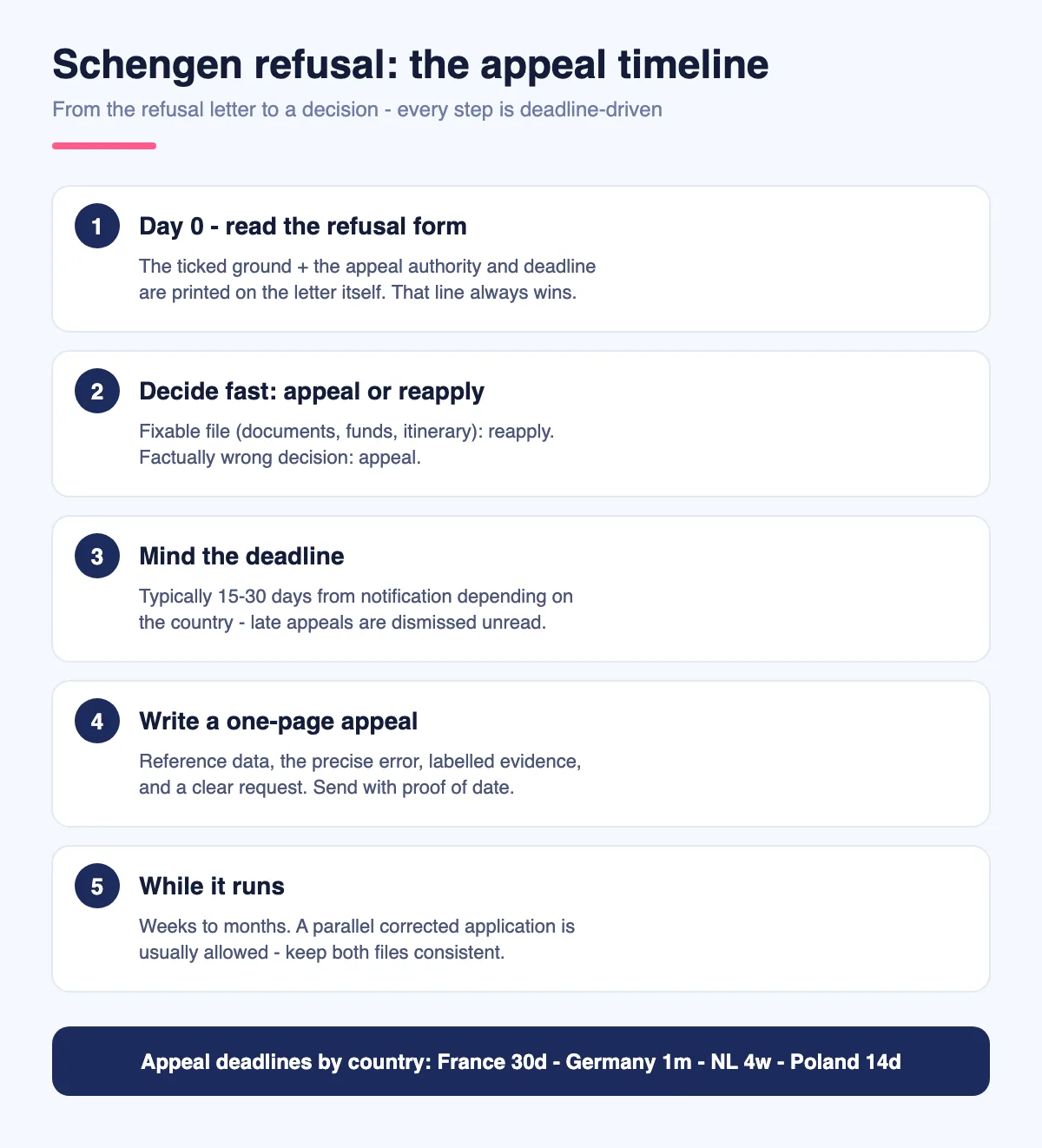
Appeal or reapply? A 30-second decision
Reapply when the refusal names something you can fix with documents: missing insurance, thin bank statements, no flight reservation, incoherent dates. Fixing the file takes days; appeals take months. Attach a short cover letter naming the previous refusal and what changed. For the itinerary piece, use a verifiable flight reservation rather than a purchased ticket — consulates advise against buying before approval.
Appeal when the decision looks factually wrong — the officer overlooked a document you demonstrably submitted, or the stated ground contradicts the evidence in your file. Appeals are also the right path when refusals repeat despite a strong file, because a successful appeal creates a decision on your record rather than another application.
Country-by-country appeal routes
The routes below are the commonly published ones for main Schengen destinations. Deadlines run from the day you are notified of the refusal. Always confirm against your refusal letter — it names the exact authority and deadline for your case.
For more context around this step, compare it with Onward ticket same day guide.
| Country | Route | Typical deadline |
|---|---|---|
| France | Mandatory prior appeal to the CRRV (Commission de recours contre les décisions de refus de visa) in Nantes; judicial appeal afterwards | 30 days (then 2 months for court) |
| Germany | Remonstration to the mission where still offered (several missions have discontinued it); otherwise direct action before the Administrative Court of Berlin | 1 month |
| Netherlands | Written objection (bezwaar) to the Ministry of Foreign Affairs | 4 weeks |
| Belgium | Appeal to the Council for Alien Law Litigation (CCE/RvV) | 30 days |
| Spain | Optional recurso de reposición to the consulate, or judicial appeal to the High Court of Justice of Madrid | 1 month / 2 months |
| Italy | Appeal to the Regional Administrative Court (TAR Lazio) | 60 days |
| Switzerland | Written opposition to the State Secretariat for Migration (SEM); fee applies | 30 days |
| Austria | Complaint to the Federal Administrative Court (BVwG) via the mission | 4 weeks |
| Sweden | Appeal to the Migration Court, filed through the authority that refused | 3 weeks |
| Norway | Appeal via the mission to UDI/UNE | 3 weeks |
| Poland | Request for re-examination by the same consul | 14 days |
| Czechia | Request for a new assessment of the refusal grounds | 30 days |
Official starting points: France-Visas for France, the German Federal Foreign Office visa service for Germany, and the Netherlands IND for Dutch decisions.
What a good appeal letter contains
Keep it to one or two pages, factual, in the language the mission works in (or English where accepted):
- Reference data — your name, passport number, application number, refusal date, and the ground(s) ticked.
- The precise error — quote the ground, then show the evidence in your file that contradicts it ("the refusal states means of subsistence were not proven; pages 4–9 of the submitted file contain three months of statements showing…").
- Supporting documents — copies of what was already submitted, clearly labelled. New documents generally belong in a new application, but attach them if they directly disprove the stated ground.
- A clear request — that the decision be reviewed and the visa issued.
Send it by a channel that gives you proof of the date — the deadline is counted in days, and late appeals are dismissed unread.
If the document needs to be ready quickly, you can book a verifiable onward ticket before check-in or submitting your file.
If you want a document you can adapt line by line, use the Schengen visa appeal letter template. It includes placeholders, an evidence index, and examples for the most common refusal grounds.
While the appeal runs
Appeals commonly take weeks to months, and there is no obligation to wait: you can usually submit a fresh, corrected application in parallel unless your letter states otherwise. If your travel date is near, the pragmatic route is almost always the new application. Keep every itinerary document consistent between the two files — contradictions between your own submissions are the one mistake that damages both. The guides on proof of onward travel and avoidable check-in mistakes help keep that part airtight.
Frequently asked questions
Is there an EU-level appeal above the member state?
No. The appeal goes to the authority of the country that refused the visa, under that country's law. EU rules require member states to offer an appeal route, but the procedure is national.
Does appealing hurt my chances of getting a visa later?
No. A reasoned appeal is a normal legal step. What accumulates badly is repeated identical applications refused for the same unfixed reason.
The deadline passed. Is everything lost?
The appeal, usually yes. The visa, no — reapply with a corrected file. For most travelers the new application was the better path anyway.
Do I need a lawyer?
For a first written appeal or remonstration, generally no — the letter above is something you can write yourself. For court-stage appeals (Berlin, TAR Lazio, Madrid), local legal help meaningfully improves the odds and is worth the cost if the trip matters.
Create a temporary flight reservation for visa files, airline checks, or proof of onward travel.